Humpty Dumpty
Humpty Dumpty is a character in an English nursery rhyme, probably first a riddle, and is usually shown as an egg, though the rhyme never says so. The earliest known version was published in Samuel Arnold’s Juvenile Amusements in 1797, and the tune was first recorded by James William Elliott in 1870.
In a children’s magazine of 1843, William Carey Richards wrote that he had come across the rhyme as a riddle when he was five years old, and that the answer was “an egg.” In the United States, George L. Fox made the character popular as a clown in the Broadway pantomime Humpty Dumpty of 1868.
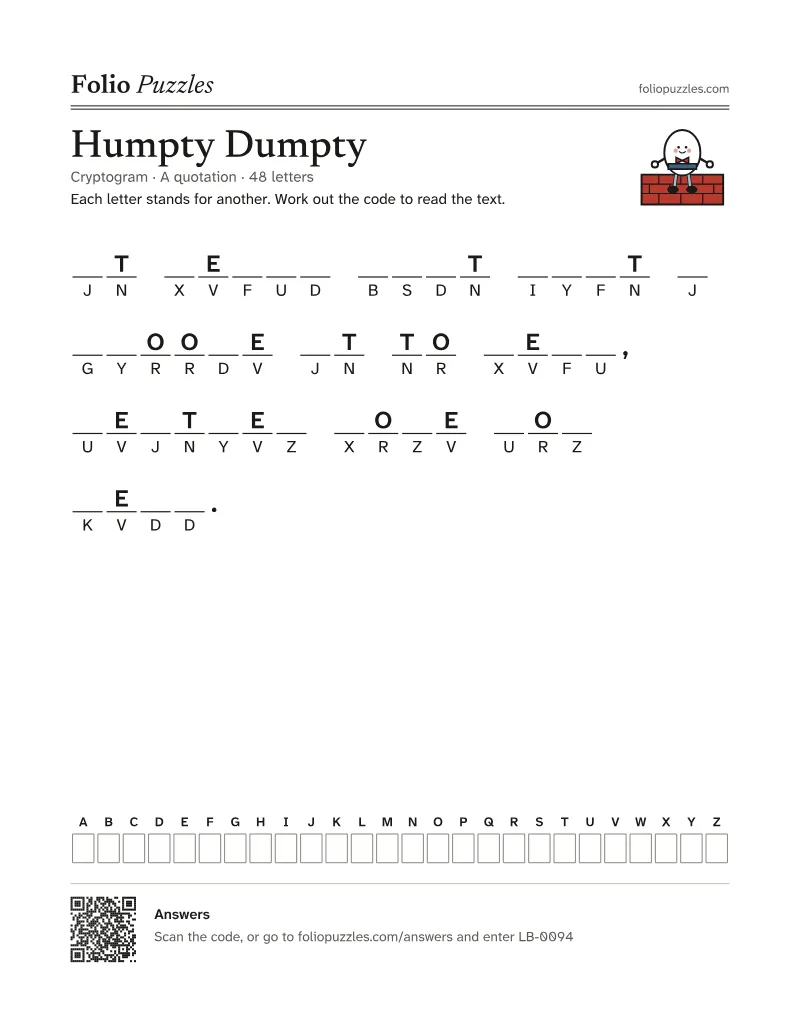
Lewis Carroll made him an animated egg in his 1871 book Through the Looking-Glass. There Humpty Dumpty explains to Alice, in rather a scornful tone, how he uses a word; his rule is hidden in this cryptogram. Three letters are given to start you off.
How to play
The text is in a simple code: every letter has been swapped for another, the same one all the way through. Work out which letter each one stands for, and write it over its code.
Easy: 48 letters, and three letters are given to start you off.
Sources
The facts on this page, and the words of the puzzle, were checked against these pages: